
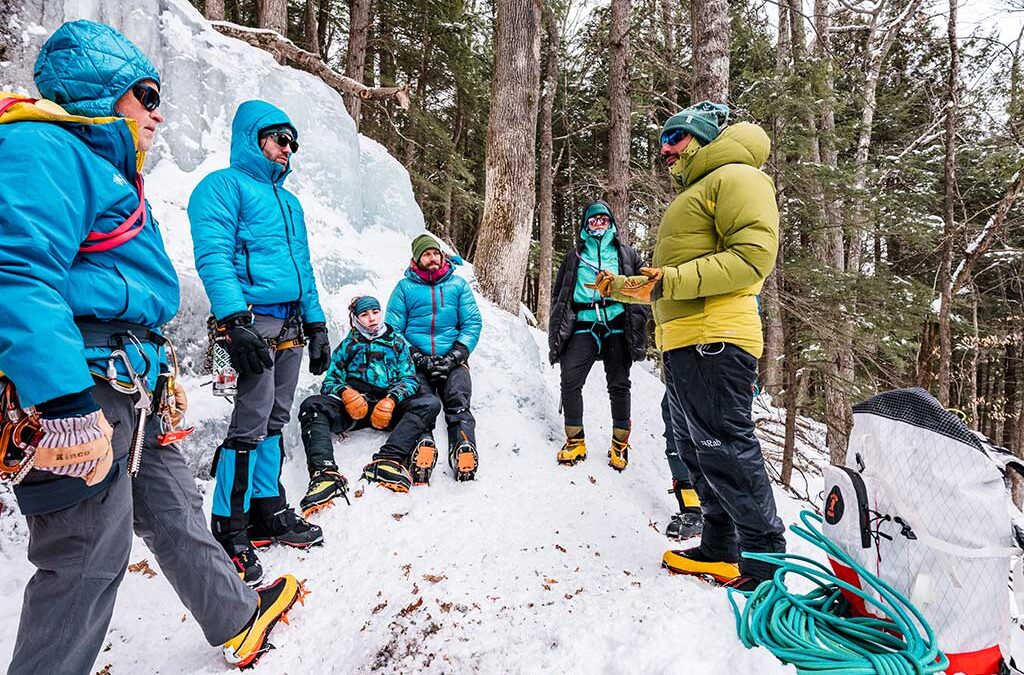
Every winter, as scores of visitors make their way to the Mt. Washington Valley to ski, another group of mountain enthusiasts are venturing to the Valley for a slightly different experience.
Words by Mike Morin • Photos by Johanna Sorrell Photography
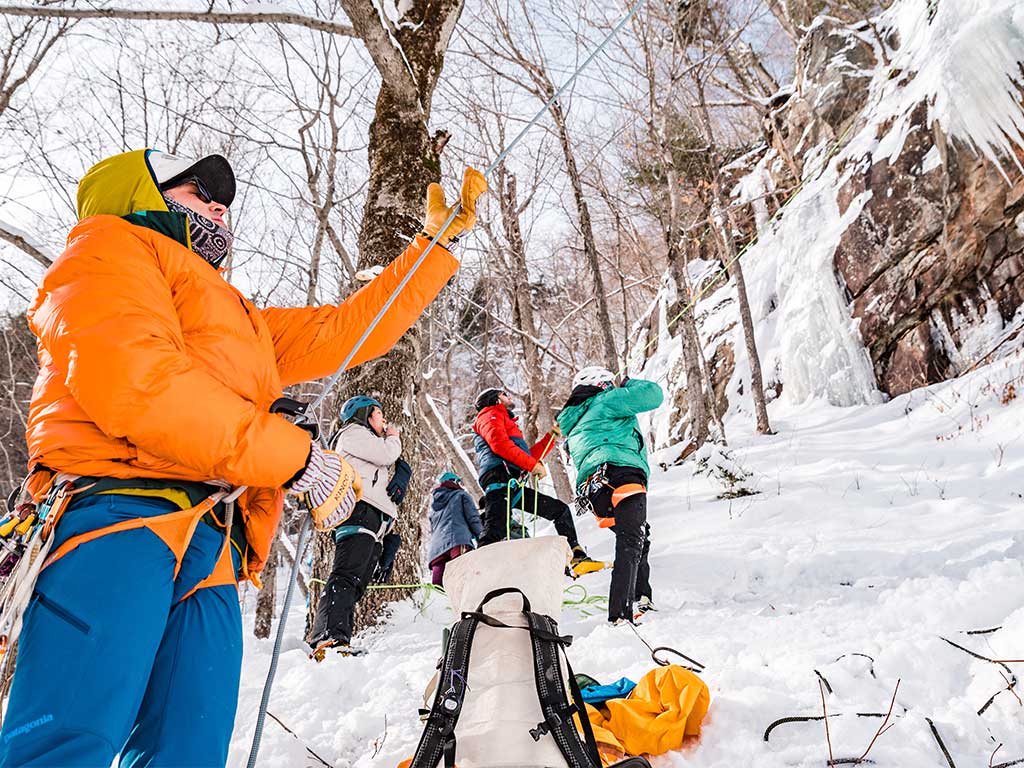
While these visitors can also be found wearing waterproof and insulated layers, stiff boots, and helmets, their pursuit doesn’t entail sliding down the Valley’s snow-covered slopes on waxed boards. These visitors arrive with gear meant to assure quite the opposite. Wearing crampons, specialized traction devices that users attach to their boots, and wielding ice axes, these visitors flock to the many natural ice falls that form each year on the cliffs and gullies of the Mt. Washington Valley.
The Mt. Washington Valley has been a destination for ice climbers since the early 1900s. Historical records indicate that Huntington Ravine was a common early destination, with ascents of Central Gully first recorded in 1927, and the neighboring Pinnacle Gully beginning to see climbing in 1930. Dedicated hikers know Central Gully for the Huntington Ravine Trail, with the gully hosting the technical portion of the trail that gives it its notoriety.
These early ice climbers used gear and techniques that bear little resemblance to what passengers riding the Conway Scenic Railroad may observe as they make their way up Crawford Notch on a winter excursion train and pass by Frankenstein Cliff and Mount Willard. Early ice climbers used a single long-handled ice axe—often referred to as a piolet, the French word for this particular style of ice axe—to chop steps up less-than-vertical ice flows, which allowed them to stand flat-footed on the icy surface with their crampon-clad boots as they made their way upward. Today, the gear has evolved significantly, with ice climbers wielding two short-handled axes, typically referred to as ice tools, and kicking directly into ice with crampons featuring serrated front points that allow ice climbers to gain purchase on vertical to overhanging ice flows in ways that the early forerunners of the sport could have only dreamed about.
The advent of ice climbing as a popular past time can be attributed directly to the innovations that took place around the ice axe, with a key moment occurring in 1970 when, in Huntington Ravine, accomplished climber Jim McCarthy arrived at the Harvard Cabin, located at the mouth of the ravine, to find a young Rick Wilcox, known today by many as the owner of International Mountain Equipment, with his wife Ceilia, holding a pair of short-handled Chouinard ice axes, which Rick had purchased from the tool’s inventor, Yvon Chouinard, the future founder of the popular retail brand Patagonia.
Using Rick’s new tools, Jim and Rick made the first one-day ascent of Pinnacle Gully, a task that had previously required multiple days using the step-chopping method. Their one-day ascent revolutionized ice climbing in the White Mountains and led the way for ice climbers across the United States.
Friends of the Ledges
 Friends of the Ledges is dedicated to the stewardship of climbing areas and preserving the tradition of climbing in the eastern White Mountains of New Hampshire and Maine. The organization is led by a board of directors and a group of active volunteers who focus on two key priorities: (1) maintaining access to climbing areas by behind-the-scenes work with landowners, land managers, and other user groups; and (2) active stewardship of climbing areas by replacing aging bolts, maintaining and improving trails, and organizing cliff clean-ups.
Learn more at www.nhledges.org.
Access Fund
 Access Fund is the national advocacy organization that leads and inspires the climbing community toward sustainable access and conservation of the climbing environment. Access Fund represents more than eight million climbers nationwide in its work to protect and conserve the land, fight for sustainable access, and build a community of inspired advocates. Access Fund supports a powerful grassroots network of more than 145 local climbing organizations, like Friends of the Ledges, across the country, putting boots on the ground to protect climbing areas.
Learn more at www.accessfund.org.
Not only did these equipment innovations drastically reduce the amount of time it took to climb a frozen ice flow, but they also opened up more vertical terrain that wasn’t previously considered by climbers relegated to chopping steps. As these tools and the climbing techniques that followed became more commonplace, a new era of ice climbing was born, opening up stunningly steep ice flows at locations such as Cathedral Ledge and the steep cliffs and gullies of Crawford Notch, including Frankenstein Cliff and Mount Willard. With this advent came a host of new climbers eager to cut their teeth on winter climbing routes and explore new terrain.
From the mid-1970s to the late 1980s, people who would become some of the most storied climbers in North America and around the world ventured up new ice-climbing routes in the Valley, many of which would become among the most popular and sought-after routes in the United States. Today, an estimated 11,889 visits to the Mt. Washington Valley occur annually by modern ice climbers drawn to the region by routes established during this era, including Dropline, Shoestring Gully, Dracula, Read Between the Lines, and Repentance.
Up until 2025, the number of ice climbers’ visits to the Mt. Washington Valley was not known. Local ice climbers, especially those around during the 1970s and 1980s, would tell you that there are a lot more ice climbers around now than back then, but establishing an exact number was nothing more than a guess. That changed following the publication of “The 2025 Mount Washington Valley Ice Climbing Study.”
MWV Ice Climbing Study Overview
• Ice climbing visitors to the Mt. Washington Valley spent an estimated $6.2 million as a result of the 2024/25 climbing season.
• Ice climbing expenditures support $2.1 million in labor income and 36 jobs in the surrounding area and state.
• The presence of ice climbing in the Mt. Washington Valley adds $4.4 million in Gross Domestic Product to the surrounding area and state.
• An estimated 11,889 ice climbing visits occur annually at the Mt. Washington Valley with local residents accounting for approximately 15% of those visits.
• Ice Fest attracted 750 persons and $375K in expenditures in 2025.
• Persons visiting the Mt. Washington Valley from 35 or more miles away typically stayed there overnight as a result of their ice climbing visit. In all, 82% chose to stay overnight, generally for around 3 days.
2026 Ice Fest Overview
The MWV Ice Fest 2026 celebrates all levels of climbers—from alpine, mixed, and glacial travel to self-rescue and lead climbing—through clinics led by pro athletes, certified guides, and veteran climbers for LGBTQIA+, women, BIPOC, adaptive, and more.
They bring in top-tier outdoor brands so participants can demo the latest climbing gear before they buy, thanks to their robust gear village.
Every evening, attendees are treated to inspiring slide shows and storytelling sessions featuring elite climbers—a chance to connect, be moved, and enjoy great company.
Their educational workshops cover big-picture issues such as mental health, community-building, mentorship, and gear repair—making this fest as intellectually enriching as it is adventure-filled.
After the climbs, après climb events offer a relaxed, joyful way to unwind: yoga, live music, massage, local art, and delicious food and brews.
Commissioned in the Winter of 2024/25 by North Conway-based Friends of the Ledges (FOTL), and the Access Fund, the study was conducted by a research team from Vermont State University with support from Dr. James Maples, an economist and sociologist, known for his work studying and reporting on the use and spending habits of rock climbers at climbing destinations across the United States.
Spurred into action by access challenges that arose in 2022 when the Conway Scenic Railroad began extending winter operations into Crawford Notch, leading to the disruption of winter-time access for ice climbers, snowmobilers, and Nordic skiers along the once seasonally dormant rail corridor, FOTL sought to better understand the economic impact of ice climber visitation on the local economy. Recognizing that future access would rely, in part, on being able to quantify ice climbing’s place in the Mount Washington Valley’s winter economy.
It was a tenuous moment in time. There was a very real concern that access to Frankenstein Cliff and Mount Willard, two of the most important ice climbing sites in the Northeast, would be effectively cut off if legal and maintainable access couldn’t be established. If that happened, there was not only concern about the loss of access for individual climbers, but also economic concerns for the guiding companies that rely on access to those sites to be successful in the winter months.
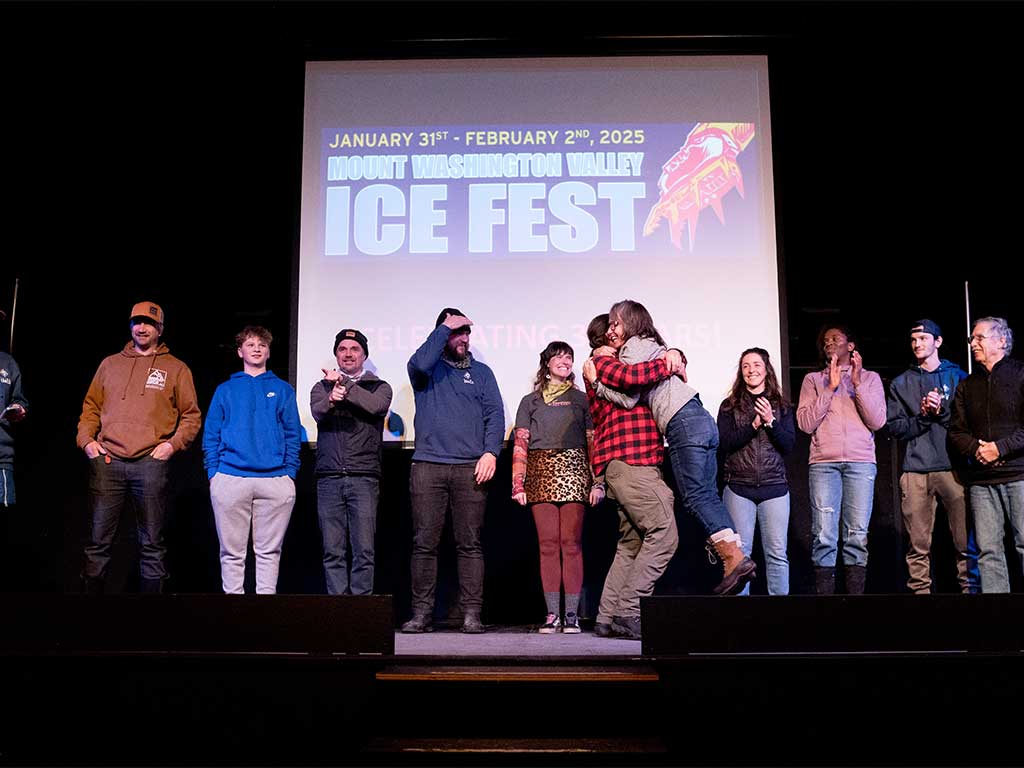
There was also concern around what loss of access would mean for the Mount Washington Valley Ice Fest. An annual, international gathering of ice climbers who come to the Mt. Washington Valley every February to participate in skills clinics taught by some of North America’s most talented climbing guides. Celebrating 33 years in 2026, the Mount Washington Valley Ice Fest was the brainchild of International Mountain Climbing School owner Rick Wilcox and Nick Yardley, who, along with co-owner Brad White, sold the climbing school in 2022 to current owners Lisa and Paul McCoy; the duo have continued to host the festival, growing its offerings and attendance each year.
“Purchasing the climbing school in 2022 was quite a twist of fate, as it was that winter that we started seeing winter rail activity commence in Crawford Notch,” recalls IMCS co-owner Lisa McCoy. “Initially, it was individual climbers who were caught off guard by encounters with railroad maintenance employees. Then word started trickling out that use of the rail corridor in the winter by climbers was going to be cut off due to the presence of winter maintenance operations, and eventually regular train service. This caused a great deal of concern for Paul and I as the new owners of IMCS gearing up to host our first Ice Fest.”
To understand Paul and Lisa’s concern, one only needs to look at the economic data revealed by The 2025 Mount Washington Valley Ice Climbing Study, which found that visiting ice climbers contributed $6.2 million annually to the local economy, and that the 2025 Mount Washington Valley Ice Fest attracted 750 participants, whose combined spending over the course of the first weekend in February, when Ice Fest is held each year, contributed $375 thousand to the local economy.
If Ice Fest became less viable due to the loss of access to two of the most popular ice climbing destinations in the Mt. Washington Valley, the financial impact to IMCS and the broader guiding community would be significant. To the relief of all who cherish ice climbing in the Valley, solutions to the access concerns began to take shape soon after the issue was identified, thanks to efforts by a citizen working group composed of IMCS co-owner, Lisa McCoy; climbing guide Laurie Watt; FOTL Board of Directors member, Mike Morin; and Access Fund regional manager, Molly Mundy. She worked with researchers to implement the study, and identify new, legal trail and parking options for accessing Frankenstein Cliff and Mount Willard. With these new access routes and parking options identified, attention is now turning to engaging with NH Department of Transportation, NH State Parks, and others to identify and address management needs, such as parking lot plowing, establishing legal railroad crossings, and improving trail segments when necessary.
“We’ve come a long way in a few years from a time when there was a great deal of uncertainty around what access to ice climbing in Crawford Notch would look like in the future,” says Mundy. “We still have work to do, and the economic impact study can help us to do that work by showing how ice climbing contributes to the local economy, and allowing us to responsibly advocate for investing resources in the management of recreational infrastructure, such as plowing parking lots that have historically only been maintained for summer access.”
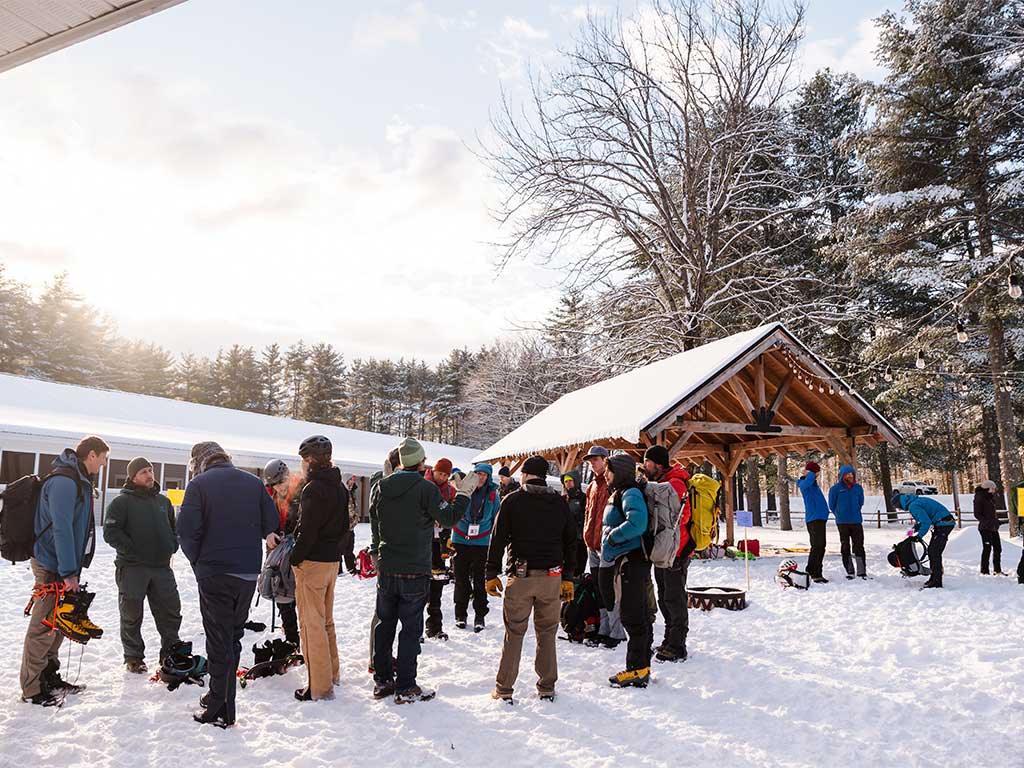
With 2026 marking 33 years of the Mount Washington Valley Ice Fest taking place, the event stands as the longest continuously running ice climbing festival in the United States. Featuring skills clinics and outings led by some of North America’s most talented climbing guides, Ice Fest is in a league of its own, thanks to the varied and accessible terrain found in the Mt. Washington Valley. At the same event, participants can choose from a guided winter ascent of Mount Washington, beginner ice climbing clinics at Cathedral Ledge, advanced climbing techniques at Frankenstein Cliff, and a multitude of other outings curated for all varieties of interests within the realm of winter climbing.
“Ice Fest has grown significantly since Paul and I began running the event,” says Lisa McCoy. “Over the past couple of years, we’ve added a number of new clinic offerings in response to demand from folks interested in coming to the Mt. Washington Valley to learn what winter climbing is all about, seeking to build upon previously established skills, or who just want to get out on a day-long vertical adventure with one of our guides.”
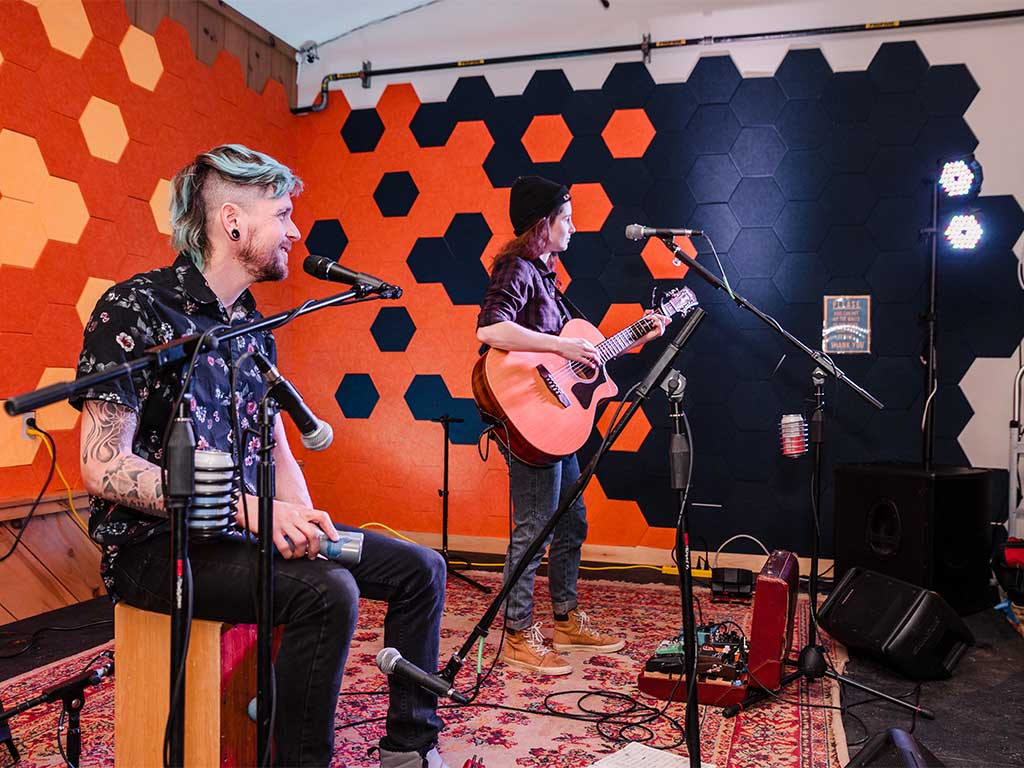
This year’s Ice Fest will feature 33 clinic options hosted from Thursday, February 5 to Sunday, February 8. Traditionally a three-day event, a fourth day (Thursday) was added for 2026, in response to demand. In addition to the daytime clinics, Ice Fest features evening speakers on Friday and Saturday night of the Fest, hosted at the Theatre in the Wood in Intervale.
“There are a number of ice climbing festivals held each year across the U.S., but there is only one Ice Fest!” says Paul McCoy. “The Mount Washington Valley Ice Fest stands out because we have some of the most accessible ice climbing venues in the region, especially for those new to the sport. We also have an exceptional pool of guides who live and work in the MWV already, along with those who travel to guide at this community-focused event. It truly is a homecoming for so many in the guiding world.
To learn more about the Mount Washington Valley Ice Fest and register for a clinic, visit www.mwv-icefest.com.
This article originally appeared in Mt Washington Valley Vibe magazine. Pick up a print copy around the Valley area today!